
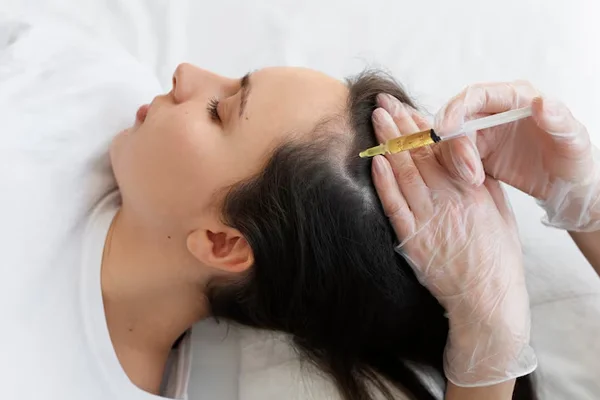
PRP for hair is a non-surgical treatment that uses platelet-rich plasma prepared from the patient's own blood. It is used as a treatment option for certain types of hair loss and thinning, particularly when hair follicles are still present but producing thinner or weaker hair.
At Smiling Faces Clinic, Fatehabad, PRP treatment can be considered for suitable patients experiencing hair thinning, reduced hair density or certain forms of hair fall. The treatment plan is based on the individual's hair condition, pattern of hair loss and overall scalp health.
PRP is not suitable for every type of hair loss, so proper assessment is important before starting treatment.
Platelet-Rich Plasma (PRP) is prepared from a small sample of the patient's own blood. The blood is processed to concentrate platelets and plasma, which are then injected into selected areas of the scalp.
Platelets contain various growth factors that are involved in tissue repair and healing. When PRP is injected into the scalp, it is intended to support the local environment around the hair follicles.
The treatment is performed without hair transplantation and does not involve surgical removal or implantation of hair follicles.
PRP may be considered for individuals with certain forms of hair thinning or hair loss, including:
The response to PRP depends on the underlying cause of hair loss, age, hair follicle health and other individual factors.
For appropriately selected patients, PRP treatment may offer potential benefits such as:
PRP should be considered as part of an overall hair-loss management plan rather than a guaranteed cure for hair loss.
The treatment begins with an evaluation of the scalp and pattern of hair loss. The doctor may also review medical history, medications and previous hair treatments.
A small quantity of blood is collected from the patient's arm, similar to a routine blood sample.
The blood sample is processed using a centrifugation technique to separate and concentrate the platelet-rich plasma.
The treatment area is cleaned and prepared before the injections.
The prepared PRP is injected into selected areas of the scalp where hair thinning or reduced density is present.
Patients receive instructions regarding scalp care and activities to avoid immediately following the procedure.
Hair follicles can become progressively smaller in certain forms of hair loss. PRP contains concentrated platelets and growth factors that may help support the local tissue environment around the follicles.
The objective is to support existing hair follicles and potentially improve hair density or thickness where follicles remain active.
PRP cannot create new hair follicles, and its effectiveness varies between individuals.
PRP treatment usually involves a series of sessions rather than a single treatment. The number and frequency of sessions depend on the patient's hair loss pattern, severity and response to treatment.
Maintenance sessions may also be considered in some cases.
A personalized schedule should be recommended after assessing the scalp and hair condition.
Hair growth is a gradual process, so PRP results do not appear immediately. Improvement, when it occurs, may become noticeable over several months.
Results vary depending on:
Regular follow-up helps assess progress and determine whether further treatment is appropriate.
PRP may be considered for certain non-scarring types of hair loss, but the underlying cause should always be identified.
Hair loss can occur due to:
Treating the underlying cause is important. PRP may be used as one component of a broader treatment plan when appropriate.
After PRP injections, patients may be advised to:
Specific instructions may vary according to the individual's treatment.
Because PRP is prepared from the patient's own blood, it is generally considered a well-tolerated treatment when performed appropriately. Temporary effects such as mild pain, redness, swelling or tenderness at injection sites can occur.
A proper medical evaluation is important before treatment to identify conditions that may affect suitability.
PRP and hair transplantation are different treatments.
PRP uses injections of the patient's own platelet-rich plasma to support existing hair follicles. It does not transfer hair follicles from one part of the scalp to another.
Hair transplantation involves surgically moving hair follicles from a donor area to areas affected by hair loss.
The appropriate option depends on the type and stage of hair loss. In some cases, different treatments may be used as part of a broader hair restoration plan.
At Smiling Faces Clinic, Fatehabad, PRP hair treatment is planned according to the patient's individual hair and scalp condition.
If you are experiencing hair fall, thinning hair or reduced hair density, identifying the underlying cause is an important first step.
Smiling Faces Clinic in Fatehabad provides PRP for hair for suitable patients after evaluating the pattern and extent of hair loss. Based on the assessment, PRP may be recommended alone or alongside other appropriate hair-loss treatments.
PRP for hair is a non-surgical treatment that uses platelet-rich plasma prepared from the patient's own blood and injected into selected areas of the scalp.
PRP is not a guaranteed permanent solution for hair loss. Its effectiveness depends on the cause and stage of hair loss and individual response to treatment.
A series of sessions is commonly recommended, but the exact number and frequency depend on the individual's hair condition and treatment response.
PRP is intended to support existing hair follicles. It cannot create new hair follicles in areas where follicles are permanently absent.
Some patients may experience mild discomfort or tenderness during and after scalp injections. The level of discomfort varies between individuals.
Hair growth is gradual. When PRP is effective, improvement may become noticeable over several months rather than immediately.
No. PRP is more suitable for certain non-scarring forms of hair loss. A professional assessment is required to determine whether it is appropriate.
Smiling Faces Clinic, Fatehabad offers PRP hair treatment for suitable patients experiencing hair thinning and selected types of hair loss.



Write a Reply or Comment