
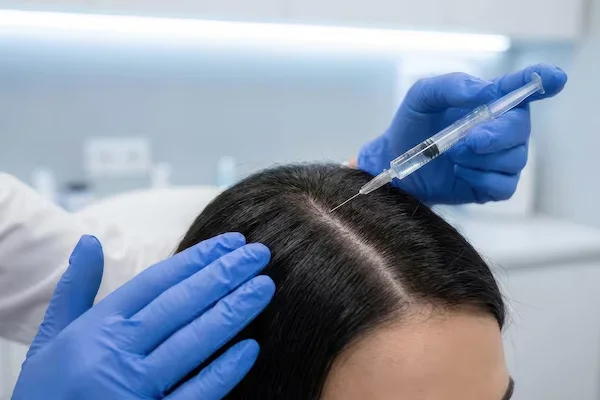
GFC (Growth Factor Concentrate) is an autologous hair treatment that uses growth-factor-rich components prepared from the patient's own blood. It is used as a non-surgical option for selected types of hair thinning and patterned hair loss.
At Smiling Faces Clinic, Fatehabad, GFC treatment can be considered after assessing the scalp, hair density, pattern of hair loss and overall treatment goals. GFC is a relatively newer platelet-derived approach, and research is still developing. Early studies suggest potential improvements in hair density and thickness in selected patients, but larger and more standardized studies are still needed.
GFC stands for Growth Factor Concentrate. The treatment uses a sample of the patient's own blood, which is processed to obtain a concentrated growth-factor-rich preparation.
Growth factors such as VEGF, EGF, PDGF and IGF-1 are involved in cellular signalling and tissue repair. GFC treatment aims to deliver these growth factors to the scalp around selected areas of hair thinning.
Unlike a hair transplant, GFC does not involve moving hair follicles from one part of the scalp to another. It is an injectable, non-surgical treatment intended to support existing follicles.
GFC may be considered for individuals with selected forms of non-scarring hair loss, particularly patterned hair thinning where viable hair follicles are still present.
It may be considered for:
A proper diagnosis is important because hair loss can have many causes, including genetics, hormonal factors, nutritional deficiencies, stress and scalp disorders.
For appropriately selected patients, GFC may offer potential benefits such as:
Recent research has reported promising changes in hair density and thickness with growth-factor injections, but current evidence also has limitations such as small studies, differing protocols and risk of bias.
GFC treatment is designed to deliver concentrated growth factors into areas of the scalp affected by hair thinning.
These growth factors may influence cellular signalling around the hair follicles and support processes involved in tissue repair and follicular activity.
The objective is to support existing hair follicles, particularly follicles that are weakened or miniaturized but still viable.
GFC cannot create new hair follicles in areas where follicles have been permanently lost.
The scalp is examined to identify the pattern and severity of hair loss. Your medical history, previous treatments and treatment goals are also discussed.
A small quantity of blood is collected from the patient's arm.
The blood sample is processed using a specialized preparation technique to obtain the growth-factor-rich concentrate.
The scalp is cleaned and prepared before treatment. Local anaesthesia or other comfort measures may be used when appropriate.
The prepared concentrate is carefully administered into selected areas of the scalp using a fine needle.
After the procedure, appropriate scalp-care and aftercare instructions are provided.
Pattern hair loss, also called androgenetic alopecia, is one of the common causes of progressive hair thinning in both men and women.
GFC may be considered as an adjunctive treatment for selected patients with pattern hair loss. A 2026 randomized controlled trial found that GFC used alongside topical minoxidil produced comparable hair-regrowth and volume outcomes to PRP alongside minoxidil, while reporting lower pain scores with GFC.
However, GFC should be viewed as a potential supportive treatment rather than a guaranteed cure for hair loss.
Both GFC and PRP are autologous platelet-derived treatments, but their preparation methods differ.
PRP concentrates platelets in plasma, while GFC protocols are designed to isolate or concentrate growth factors released from platelets.
Some comparative studies have reported promising outcomes with GFC, while other research shows that PRP can have sustained benefits depending on the treatment protocol. Current evidence does not establish GFC as universally superior to PRP.
The choice between GFC and PRP should therefore be based on the patient's diagnosis, treatment goals and professional assessment.
The number of GFC sessions varies according to the individual's hair condition, treatment protocol and response.
A series of sessions may be recommended rather than a single treatment. Published studies have used different treatment schedules, so there is no single universally accepted GFC protocol.
Your treatment plan should be customized after evaluating the scalp and hair-loss pattern.
Hair growth is a gradual process, so results are not expected immediately after treatment.
If a patient responds to GFC, changes in hair shedding, thickness or density may become noticeable gradually over the following weeks and months.
The response depends on the underlying cause of hair loss, follicle health, treatment protocol and individual factors.
GFC is a minimally invasive injectable treatment and generally involves limited downtime.
Temporary effects may include:
These effects generally settle as the scalp recovers. Specific aftercare instructions should be followed after treatment.
Because GFC is prepared from the patient's own blood, it is an autologous treatment. However, blood collection and scalp injections can still have potential risks, including pain, bruising, infection or local irritation.
A proper medical assessment is important before treatment, particularly for individuals with certain blood disorders, scalp infections or other relevant health conditions.
GFC should not be promoted as a guaranteed cure for hair loss.
Its potential benefit depends on the underlying cause and stage of hair loss. It is more relevant when viable hair follicles are still present.
Research on GFC is promising but still developing, with current studies limited by small sample sizes, different treatment protocols and a lack of large long-term trials.
Depending on the diagnosis, GFC may be considered alongside other hair treatments, such as:
A combination approach should be planned according to the individual's condition rather than used routinely for everyone.
At Smiling Faces Clinic, Fatehabad, GFC treatment is planned according to the individual's hair-loss pattern and scalp condition.
If you are experiencing hair thinning, reduced hair density or patterned hair loss, GFC may be one of the non-surgical treatment options to discuss with a qualified professional.
At Smiling Faces Clinic, Fatehabad, your scalp and hair condition can be assessed to determine whether GFC is appropriate and whether it should be used alone or alongside other hair-loss treatments.
The goal is to develop a personalized treatment plan based on your hair condition, realistic expectations and individual requirements.
GFC stands for Growth Factor Concentrate. It is an autologous treatment prepared from the patient's own blood and used to deliver a growth-factor-rich preparation to selected areas of the scalp.
GFC may help selected patients with certain types of hair thinning and patterned hair loss. Results vary between individuals.
There is currently no definitive evidence that GFC is universally better than PRP. Both treatments have different preparation methods, and results can depend on the patient and treatment protocol.
The number of sessions depends on the type and severity of hair loss and the treatment protocol. A personalized plan is recommended after assessment.
Some discomfort may occur during scalp injections. Appropriate comfort or numbing measures may be used when required.
Most patients experience limited downtime, although temporary tenderness, redness, swelling or bruising can occur.
GFC cannot create new hair follicles where follicles have been permanently lost. Its potential benefit is mainly related to supporting existing viable follicles.



Write a Reply or Comment