
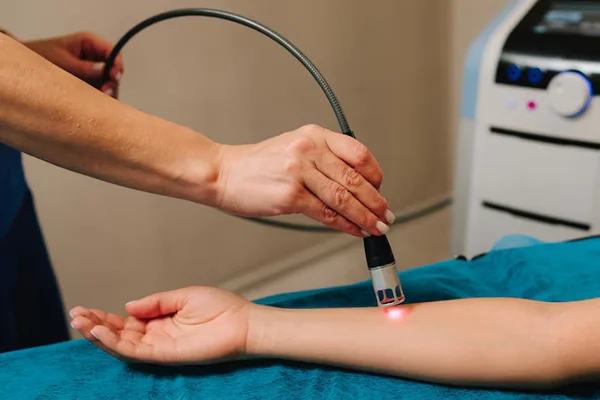
Low-Level Laser Therapy (LLLT), also known as low-level light therapy or photobiomodulation, is a non-invasive treatment option used for selected types of hair thinning and hair loss. It uses low-intensity light directed at the scalp with the aim of supporting cellular activity around hair follicles.
At Smiling Faces Clinic, Fatehabad, Low-Level Laser Therapy can be considered after evaluating the patient's scalp condition, pattern of hair loss and treatment goals. It may also be used as part of a broader hair-care plan when appropriate.
Low-Level Laser Therapy uses low-intensity laser or light energy without significantly heating or damaging the skin. In hair treatment, the light is directed towards the scalp and areas affected by thinning.
The treatment is designed to provide light energy to the scalp and may support the function of existing hair follicles.
LLLT is generally considered a non-surgical and non-invasive approach.
Low-Level Laser Therapy may be considered for selected patients experiencing:
A proper diagnosis is important because hair loss can have many causes. LLLT may not be appropriate for every type of hair loss.
For suitable patients, LLLT may offer potential benefits such as:
Results vary according to the cause and severity of hair loss and individual response.
LLLT delivers low-intensity light to the scalp. The light is thought to interact with cells in the treated area and may influence cellular processes around hair follicles.
The objective is to support the function of existing follicles and potentially improve the appearance of hair density over time.
It is important to understand that LLLT does not create new hair follicles and is not a guaranteed treatment for every form of hair loss.
The scalp and pattern of hair loss are assessed to determine whether LLLT may be suitable.
The treatment schedule and areas to be targeted are determined according to individual requirements.
The LLLT device is positioned over the selected scalp areas. Low-intensity light is delivered for the recommended treatment duration.
The device is removed after the session. There are generally no incisions or wound-care requirements.
Progress can be reviewed periodically to assess the response to treatment and determine whether the treatment plan needs adjustment.
The duration of an LLLT session can vary depending on the device used, treatment area and treatment protocol.
A healthcare professional will explain the expected session duration and recommended frequency during consultation.
LLLT generally requires repeated treatments rather than a single session.
The number and frequency of sessions depend on:
Consistency is important when using light-based hair treatment.
Hair growth is a gradual process, so improvements do not usually appear immediately.
If a patient responds to treatment, changes may become noticeable over several weeks or months. Regular treatment and appropriate follow-up are important for assessing progress.
Results vary between individuals.
Depending on the diagnosis, LLLT may be considered alongside other hair treatments such as:
Combining treatments should only be considered after professional assessment.
One of the advantages of Low-Level Laser Therapy is that it is non-invasive and generally requires little or no downtime.
Patients can typically return to their normal routine after treatment, subject to any specific instructions provided by the healthcare professional.
LLLT is generally considered a well-tolerated non-invasive treatment when used appropriately. However, suitability depends on the individual's health, scalp condition and the specific device being used.
Patients should inform the healthcare provider about existing scalp conditions, medications and other relevant health concerns before starting treatment.
LLLT should not be considered a guaranteed cure for hair loss.
Its potential benefit depends on the type and stage of hair loss and whether viable hair follicles are present. Identifying and addressing the underlying cause of hair loss remains an important part of treatment planning.
At Smiling Faces Clinic, Fatehabad, Low-Level Laser Therapy is considered as part of a personalized approach to hair and scalp care.
If you are experiencing hair thinning or reduced hair density, Low-Level Laser Therapy may be one of the treatment options worth discussing with a professional.
At Smiling Faces Clinic, Fatehabad, your scalp and hair condition can be assessed to determine whether LLLT is suitable and whether it should be used alone or as part of a broader hair-treatment plan.
LLLT is a non-invasive light-based treatment that delivers low-intensity light to the scalp and may support existing hair follicles in selected cases of hair thinning.
LLLT may help selected individuals with certain types of hair loss, particularly some forms of pattern hair loss. Results vary.
LLLT is generally considered a comfortable treatment because it does not involve injections or surgical procedures.
Repeated sessions are generally needed. The recommended frequency depends on the type of hair loss and treatment device.
Hair growth takes time. If treatment is effective, visible changes may develop gradually over several weeks or months.
LLLT may be combined with treatments such as PRP in selected cases, depending on the patient's diagnosis and treatment goals.
No. LLLT does not create new hair follicles. Its potential benefit is primarily related to supporting existing follicles.
Smiling Faces Clinic, Fatehabad provides consultation for Low-Level Laser Therapy and personalized hair-loss treatment planning.



Write a Reply or Comment